In a previous post, we explored how leverage can be used to reprogram our autopilot.
Today, we close the first layer of The Wolf System by demystifying one of the heaviest words in our vocabulary:
Impossible.
The “Impossible” Sign
The art of building the impossible begins with understanding what the word actually means.
In the context of human engineering, impossible is not an absolute truth about the world.
It is a feedback signal from your internal system.
It is the voice of your balance loop defending its primary function: saving energy.
When you say,
“It’s impossible to change this habit,”
your system is not making a philosophical statement.
It is reporting a structural reality:
The current setup is too strong. Any deviation will cost more energy than the system is willing to spend.
This resistance is not a flaw.
It is the system doing exactly what it was designed to do.
The mistake is trying to fight it.
The solution is to build a competing system.
The River of Disorganisation vs. the Channel of Order
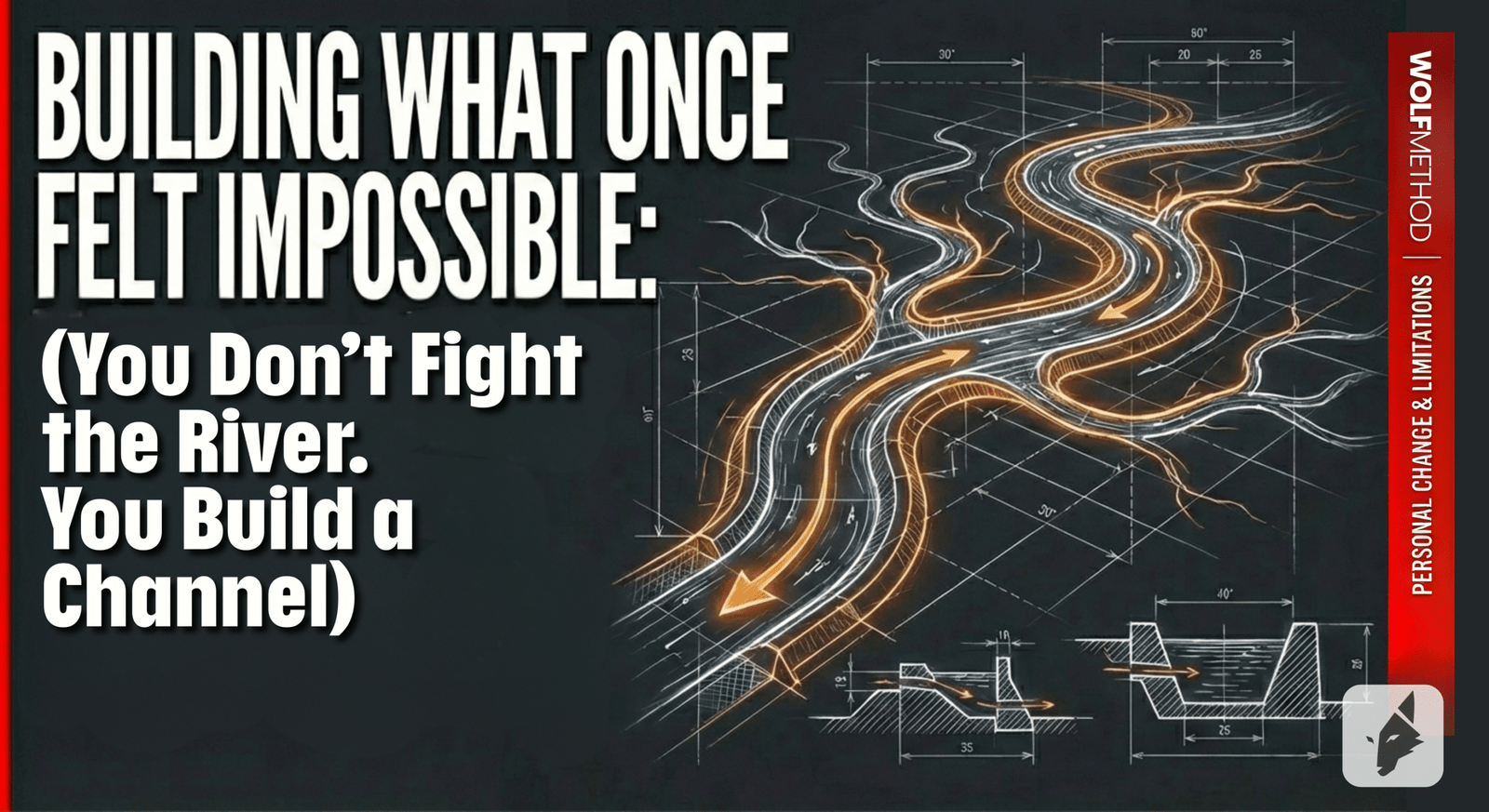
Imagine your current habits as a wide, deep river.
The River of Disorganisation
Your system is optimised for this flow.
- Putting things off saves immediate energy
- Impulse decisions deliver fast rewards
- Tidying up feels like effort with no return
Trying to become “organised” overnight is like trying to make a river flow back toward its source.
It feels impossible because, structurally, it is.
Build the Competing Channel
Instead of trying to stop the river, you dig a parallel channel.
1. The First Tidy-Up (An Unnatural Action)
You don’t tidy the whole house.
You choose one small lever.
Make the bed when you wake up.
Two minutes.
No motivation required.
Almost pointless.
This is not about cleanliness.
It is about diverting the first thread of water.
2. Feed the New Flow
You repeat the action daily.
Then you add another small behaviour:
- Taking one object back to its place before leaving a room
- Clearing a single surface, not the entire space
You are not “fixing” disorganisation.
You are feeding a reinforcement loop.
An identity begins to form.
3. The Change of Dominance
After weeks and months, the channel becomes a stream.
Not making the bed now feels strange.
Order begins to feel normal.
The identity of “an organised person” becomes the dominant loop.
The old river still exists.
But it no longer controls where your energy flows.
You didn’t fix the problem.
You outbuilt it.
Your Engineering Project (Questions for Reflection)
Use these questions to map your next build:
- What is your current main river — the automatic behaviour that keeps pulling you where you don’t want to go?
- What “impossible” signal does it send you?
- If you had to make first landfall today, what is the smallest unnatural action you could take to divert energy in your favour?
- How could you make your old version obsolete instead of trying to repair it?
Closing Layer 1: The Central Dynamic
With this, we conclude Layer 1: The Central Dynamic.
You now understand the reinforcing and balancing forces that govern change.
In the next post, we move up a level.
We will open the bonnet of the system and explore
Layer 2: The Architecture of the Internal System.
You’ll meet the two entities that inhabit you:
The Wild Horse
and
The Intelligent Knight.
Subscribe to the newsletter to receive the next layer directly in your inbox.