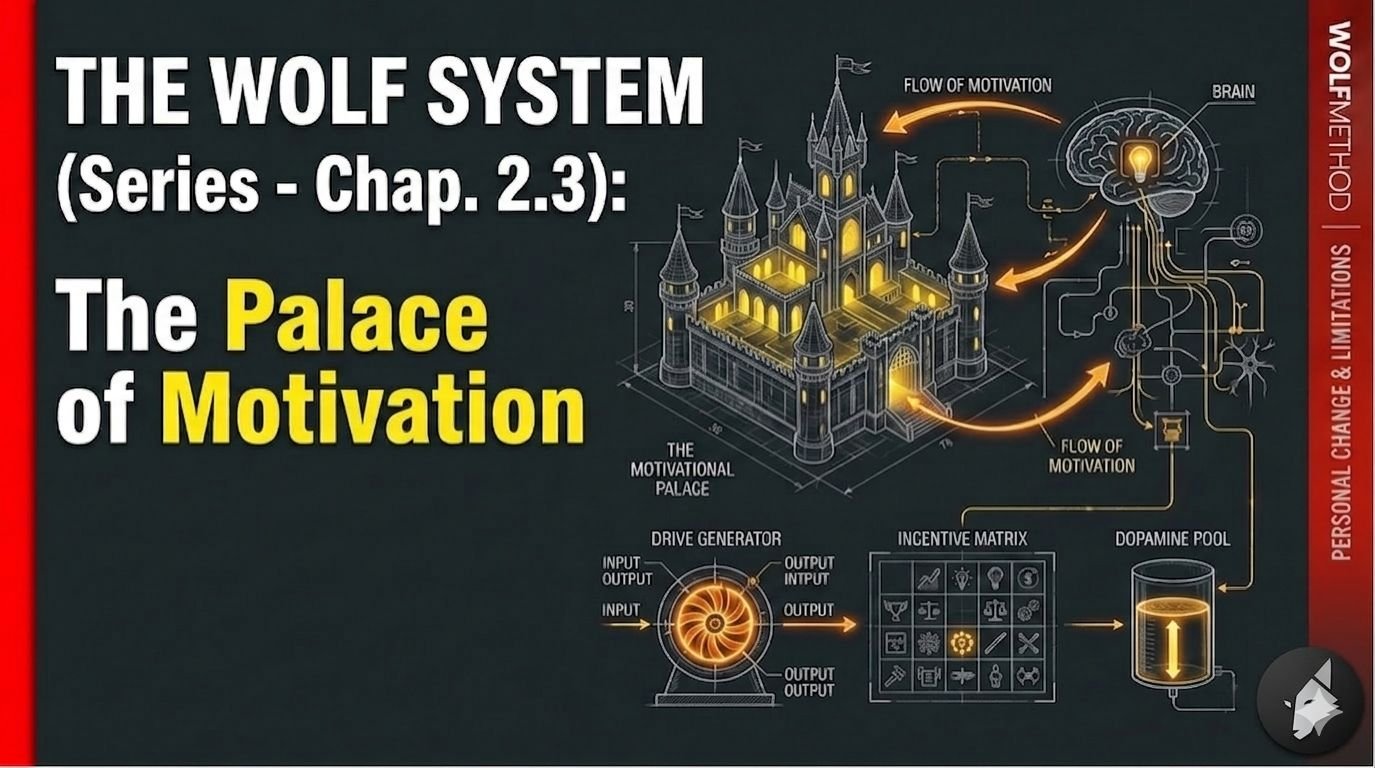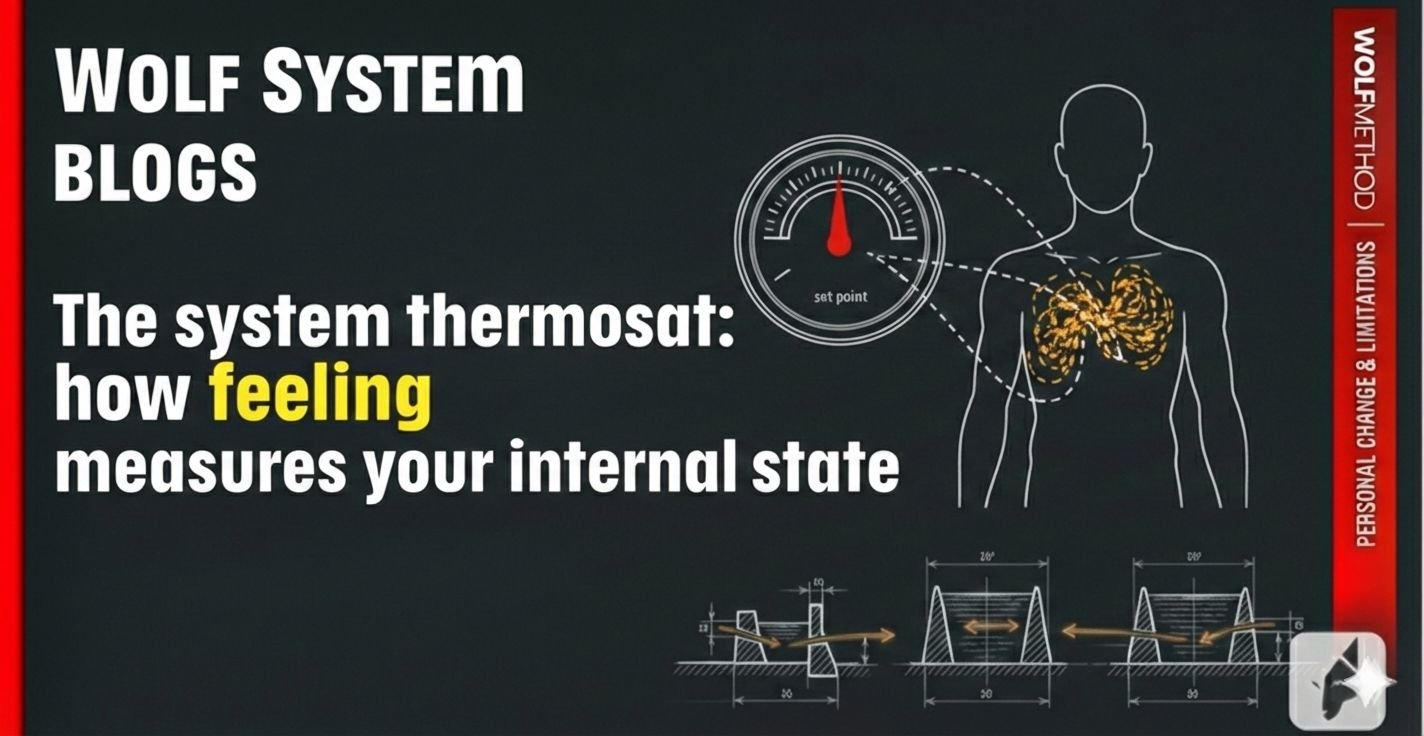
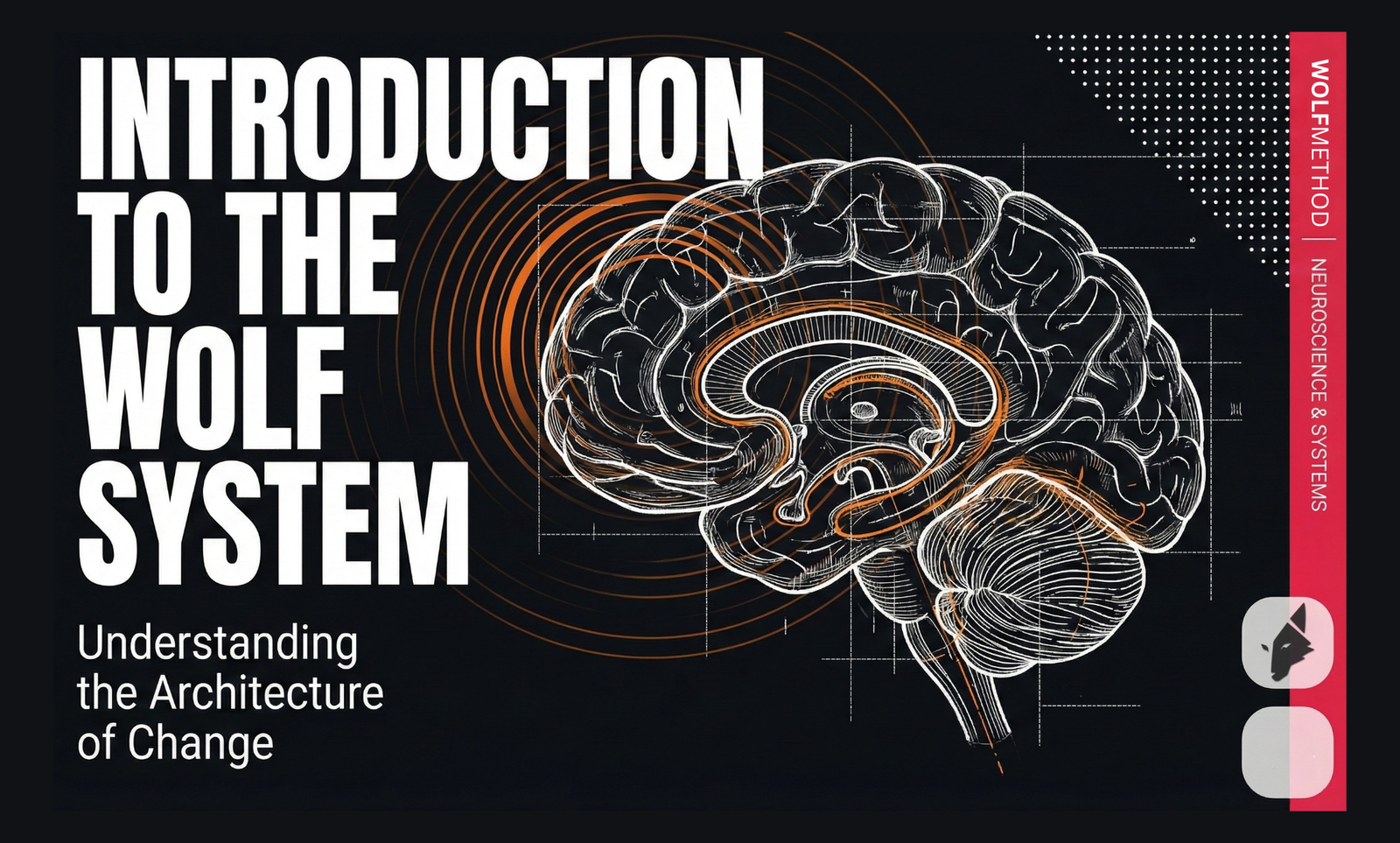
Today, we officially begin the series “The Wolf System.”
The text that follows is the introduction of the book, “The manual of the ‘system’.” It defines the rules of our commitment.
This is not a self-help book it is an operations manual.
The premise is simple: lasting behavioural change does not happen through willpower or inspiration, but through the understanding and deliberate management of the complex “system” that is you.
Here, you will learn to see yourself not as a person who needs to be “fixed,” but as a dynamic system that can be understood, modelled, and optimised.
Most attempts at change fail because we fight the wrong enemies.
We fight the symptoms without understanding the structure that causes them.
We try to overcome procrastination (a symptom) without understanding the energy-balance loop (the structure) that generates it.
This manual offers a different approach: instead of fighting your “system,” you will learn to work with it.
You will learn to identify the root causes and use leverage points to obtain more results while using less energy.
By understanding your own architecture its feedback loops, stocks, flows, and leverage points you gain the ability to create effective and permanent change.
You learn to turn laziness and procrastination into allies by knowing how to spend energy intelligently.
This resistance is not a failure; it is the function of the “system” to keep you in balance.
The solution, therefore, is not to fight this force with inspiration, but to understand it and use other mechanisms of your own “system” to bypass it.
And what if instead of learning from “recipes” that ignore this force, you learned from the methods our biological system has used for billions of years methods that have always worked?
Wouldn’t it be easier?
This guide aims to help you discover those secrets so that you stop fighting so much in life and finally have time to live it.
The “Intelligent Hydraulics” Approach
Imagine that your personal finances are a water tank.
Your goal is to increase the water level (your savings).
This tank has an inlet tap (income) and an outlet tap (expenses).
A stubborn problem called “unnecessary spending” keeps the water level always low.
Fighting spending directly is like trying to block the outlet tap with your hands.
It is an effort of pure willpower — exhausting and frustrating.
As soon as you get distracted, the water begins to leak again.
Why?
Because you did not address the mechanics of the system that opens that tap.
The Intelligent Hydraulics approach works differently:
1. Identify the Structure
You analyse the “plumbing.”
You realise your “outlet tap” opens strongest every night (ordering food delivery).
Why?
Because your mental energy is low after a workday.
App notifications act as the trigger, and your stored credit card is the environment that makes the flow easy.
That is the system that causes the leakage.
2. Find the Leverage Point
The greatest leverage is not “having more willpower,” but changing the conditions that create the need and ease of spending.
3. Adjust the System
On Sunday, you dedicate one hour to preparing meals for the week (increasing your stock of ready food).
You turn off delivery-app notifications and remove your stored credit card.
You are not fighting the flow of water — you are closing the valve and reducing the system pressure that caused the leakage.
Reflection Questions (Your First Exercise)
This is not passive reading.
Begin thinking like a systems architect now.
Reflect or leave your answer in the comments:
• What is a recurring leak in your finances?
• Instead of focusing on the act of spending, what system conditions (energy level, triggers, ease of access) keep that tap open?
• What is the smallest, simplest change you could make to make saving easier and impulsive spending harder?
The Road Ahead
The manual is organised into four layers:
- The Central Dynamic that governs all change.
- The Architecture of your internal system.
- The Operations Manual, where you learn tactics to pilot your system.
- The System in Action, shown in a case study.
The goal is to transform you from a passenger into the architect of your own life.
In the next post of the series, we will begin Layer 1 with the chapter:
“The Starting Point: the reinforcing ‘action loop.’”
To ensure you do not miss any chapter in this sequential journey, subscribe to the newsletter below.
You will receive each part of the manual directly in your email.
Louis Wolf.